
Big Idea #2 - Circuits control the flow of electric charge
S8P5c. Investigate and explain that electric currents and magnets can exert force on each other.
 |
| (c) M. Prince, 2013 |
 | |
|
Static Charge (static electricity) and Static Discharge (static shock, lightning)
Static Charge is the building of electric charges in an object; unbalance number of protons or electrons, thus creating a positive or negative charge.
 |
| (click to visit original website) |
 |
| (click to visit original website) |
Questions to Consider:
1. What, from the balloon, is attracting the positively charged particles from the strands of hair?
2. How can a Van de Graaff generator make a person's hair stand on end?
Static Discharge occurs when the build up of charges moves out of an object into a new location.
| (click to visit original website) |
 |
| (Click to visit original website) |
Questions to Consider:
1. What is going on in part one of the first image that explains how static discharge works?
2. How can the first image be used to explain the connection between the storm clouds and the ground during the storm in the second image?
Read more...
Moving Electrons and Charges
Electricity and Magnetism Module
Electricity and Magnetism Interactives
Balloons and Static Electricity
Building Circuits Simulation
Ohm's Law Simulation
Electrical Opens and Shorts Simulation
Electromagnets (HS Level)
ELECTRICITY JOKES
Q: How did Ben Franklin feel when he discovered electricity?
A: He was shocked!
Q: Why did the foolish gardener plant a light bulb?
A: He wanted to grow a power plant!
Source: http://mssell.tamu.edu/products/Energy2-web.pdf
S8P5b. Demonstrate the advantages and disadvantages of series and parallel circuits and how they transfer energy.
 |
| (c) M. Prince, 2013 |
The power source is measured in volts (v). The wire path that allows the current to run through is measured in amperes (amp). This lets you know how many electrons pass at a given amount of time. (Sounds like frequency in our waves unit, don't you think?) Then there is the resistor that is measured in ohms (Ω). This measures the amount of resistance in an electrical device, such as a light bulb. Resistors slow the flow of electric charge in a circuit.
What happens when you have an open circuit? What happens when you have a closed circuit?
 |
| (c) M. Prince, 2013 |
 |
| (c) M. Prince, 2013 |
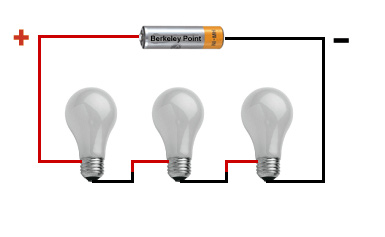
What does a series circuit look like?
 |
| Source: http://www.berkeleypoint.com/images/series.jpg |
A series circuit consists of one loop that includes one or more power sources and resistors.
What would the resistors in this model represent? This is a circuit diagram. Each symbol represents one piece of a circuit.
 |
| Source: http://www.physics247.com/physics-tutorial/images/seriescircuit.jpg |
What does a parallel circuit look like? What do the symbols in the circuit diagram represent?
 |
| Source: https://blogger.googleusercontent.com/img/b/R29vZ2xl/AVvXsEi10d2qmaxjlbcV0ZKGEamotXIpI6W8v7Y5HjlgRVKAGEXJrV8lX8IlJ8tqMOphgZYAa0Ql8DPl7waNT8V02yrUjoj_q5IhRk3r1qkwkGlsCWP2qfriTlijaBPVGrXzYpgHv6BPFvg3A8Ak/s1600/Parallel-Circuits.jpg |
Ohm's Law

Did you know that there is a relationship between the current, voltage, and resistance from the electrical energy produced in a circuit?
Legend:
The symbol for current is I and the SI unit of measurement is A for amps.
The symbol for voltage is V and the SI unit of measurement is V for volts.
The Relationship:
If you increase the resistance, you decrease the amount of current that can flow through.
If you decrease the resistance, you increase the amount of current that can flow through.

If you increase the voltage, you will increase the amount of current that flows through.
If you decrease the voltage, you will decrease the amount of current that flows through.

Voltage and resistance determine the amount of electrical current flowing through a wire.
If you increase the resistance, then you must increase the voltage.
If you decrease the resistance, then you must decrease the voltage.
How would you draw this one?
Read more...
Moving Electrons and Charges
Electricity and Magnetism Module
Electricity and Magnetism Interactives
Balloons and Static Electricity
Building Circuits Simulation
Ohm's Law Simulation
Electrical Opens and Shorts Simulation
Electromagnets (HS Level)
Did YOU Know?
Have you ever wondered why some electric plugs have a third prong?
.JPG) |
| Source: http://www.csionline.org/documents/6thsample.pdf |
Read more...
Moving Electrons and Charges
Electricity and Magnetism Module
Electricity and Magnetism Interactives
Balloons and Static Electricity
Building Circuits Simulation
Ohm's Law Simulation
Electrical Opens and Shorts Simulation
Electromagnets (HS Level)
Happy Learning!


