What Are Simple Machines and How Do They Make Our Work Easier?
What do you think work is in physical science? Perhaps, you think it means to complete your assignments. Well that's one way to look at it, but this is not the scientific definition of work. Work is the use of force required to move an object some distance. Looking at the screen right now is not an example of doing work (in scientific terms), but using your finger to apply a push force on the mouse in order to navigate throughout this blog is work! To measure the amount of work done on an object you calculate the product between the force applied and the distance covered. In other words, Work = Force x Distance (W=Fd). Just one other thing, for work to have occurred on an object the object must move in the same direction as the applied force. The SI unit for work (how work is measured) is joule.
Simple machines are devices that help us do work. Simple machines don't lessen the amount of work they just make completing the task quite a bit easier by changing how the work is done. Think about it: If I decided to use my hands to cut the front lawn that would be a lot of hard work. If I use a machine, like a lawnmower, it would still be a lot of work to cut the grass, but it makes cutting the grass easier.
How do simple machines make work easier, you ask? Here's how:
1. By changing the size and distance of the applied force.
If my input force (applied force by you) is great then my output force (force exerted from machine) may be minimal over a distance. If the input force is minimal then the output force will be greater over a distance.
2. By changing the direction of the force.
If my input force moves in a downward direction, the output force will move in an upward direction and vice versa.
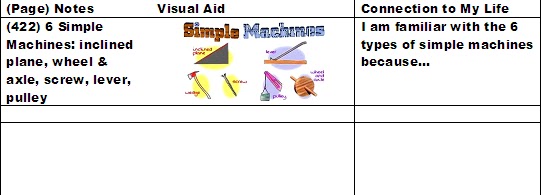
There are six types of simple machines:
Levers


A lever is a bar that rotates or turns around a fulcrum (a fixed point). There are three types: first class, second class, and third class. The seesaw is a 1st class lever because its fulcrum is between the input and output forces (people on the seesaw, for example). The baseball bat is a 3rd class lever because your hands serve as the fulcrum at one end of the bat. The input force is between the fulcrum (your hands) and the output force (higher end of bat). What about a 2nd class lever? Well, let's look at a wheelbarrow. Where would the fulcrum (fixed point) be located? Where is the input force applied on the wheelbarrow? Where is the output force then? What general statement could you make for identifying 2nd class levers based on this example?
Screws
 |
| Original Source: Click here |
A screw is an inclined plane wrapped around a cylinder to form a spiral. Screws are used to lift and lower weights as well as hold things together. If the threads on the screw are closer together the applied force will be exerted over a greater distance. However, if the threads on the screw are farther apart, the applied force will be exerted over a smaller distance. Think about the number of turns screws with different threading have to make in order to secure them in place.
Wedges


A wedge can have one or two inclined planes. They are useful in cutting or splitting things apart. Hmmm, that means my teeth are great examples of wedges because their are always tearing food apart so that it can be digested. Some wedges can even hold things together. Wedges can be movable or stationary. The doorstop that keeps the door open in the classroom is a movable wedge. Thin wedges (kitchen knife) require less input force (you) to get the job done (slicing bread). Thick wedges (butter knife) require more input force (you) to get the job done (not easy to slice bread with the dull wedge).
Pulleys
 |
| Original Source: Click here |
A pulley is a wheel with a grooved rim that requires a rope or cable to ride through the groove. There are three types of pulleys: fixed, movable, and combination. A fixed pulley allows you to pull downward to move a load upward. (Think of the flagpole outside of the school.) A movable pulley is where the load is attached to the wheel (see above right). A combination pulley is both fixed and movable and is used to haul and lift heavy objects.
Inclined Planes
 |
| Original Source: Click here |
An incline plane has a sloping surface. This simple machine makes it easier to raise the height of an object. The less steep an incline plane is the less force necessary to move it (and the farther the object must travel). The greater the steepness of an inclined plane the greater amount of force required to move the object.
Wheel and Axle
.jpg) |
| Original Source: Click here |
Compound Machines: Rube Goldberg Projects
What do you get when you put two or more simple machines together? You get compound machines! I love looking at the Rube Goldberg projects that people create. How many simple machines can you identify in each compound machine?
...and of course my absolute favorite
Other compound machines can be found right in your home:
Cars
Fishing rod
Scissors
Bicycle
Simple Machine Resources
Edheads - http://www.edheads.org/activities/simple-machines/
Franklin Institute - http://www.fi.edu/qa97/spotlight3/
MIKIDS - http://www.mikids.com/Smachines.htm
Chicago Museum of Science - http://www.msichicago.org/online-science/simple-machines/
Museum of Science - http://legacy.mos.org/sln/Leonardo/Inventorstoolbox.html
Essence of Simple Machines - http://www.cosi.org/downloads/activities/simplemachines/sm1.html
Answer Key to Force and Motion Quiz:
1. C 2. C 3. B 4. C 5. C 6. C 7. A 8. B 9. A 10. a 11. b
12. STATIC 13. MASS 14. SLOPE 15. ACCELERATION
16. TRUE 17. TRUE 18. FALSE 19.TRUE
20. B